
I Read the Christchurch Puppy Case So You Don't Have To
The most hated word in residential tenancy is reasonable.
Not Tribunal. Not eviction. Not even wear-and-tear.
Reasonable.
Property managers despise it. Landlords freeze when they hear it. Tenants feel like they are being sold a false bill of goods. I've spoken at dozens of industry events, and every single time, every single time, someone tells me a version of, "What the heck is reasonable?!" And for years, the industry, me included, has offered the same useless non-answer: "It depends."
Wow. So helpful. Let me just consult my crystal ball to see if the Tribunal is going to buy my gut feel. Suffice to say, everyone is desperate for a roadmap. Something, anything, that turns this abstract legal concept into actual guidance we can use without needing a law degree and a Xanax prescription.
It's almost like the Tribunal heard us
Most of us will be familiar with the Christchurch puppy case by now. While I continue to maintain that the outcome is remarkably unremarkable, what really stands out to me is Adjudicator Carter's two-stage analysis of the landlord's reasons for withholding consent. It's a useful framework that takes "reasonableness", this vague, anxiety-inducing concept, and turns it into a process that can be reverse-engineered into reliable guardrails for navigating the pet-consenting process.
That means no more guessing, and no more saying your Hail Marys after a no. There’s finally a good amount of clarity to help landlords arrive at a legally robust decision.
And here's why that clarity matters more than it might first appear. Withholding consent unreasonably is an unlawful act under the Act. That exposes the landlord, and the property manager advising them, to a Tribunal finding and potential exemplary damages. The Christchurch property manager escaped a financial penalty only because the law was so new the Tribunal exercised restraint. That grace period is not going to last forever*.
The two-stage framework: How reasonableness actually works
Here is the structure:
Stage One (Factual): Why was consent withheld, and what were the reasons?
Stop being vague and don't hide behind generalities. Write. It. Down.
This is what I have been calling the “lazy no”: a refusal that’s built on a feeling and dressed up as risk management. Bah humbug. You will lose, every time. The opposite is a “defensible no”: a specific, evidenced concern tied to this pet and this property. The difference is stark:
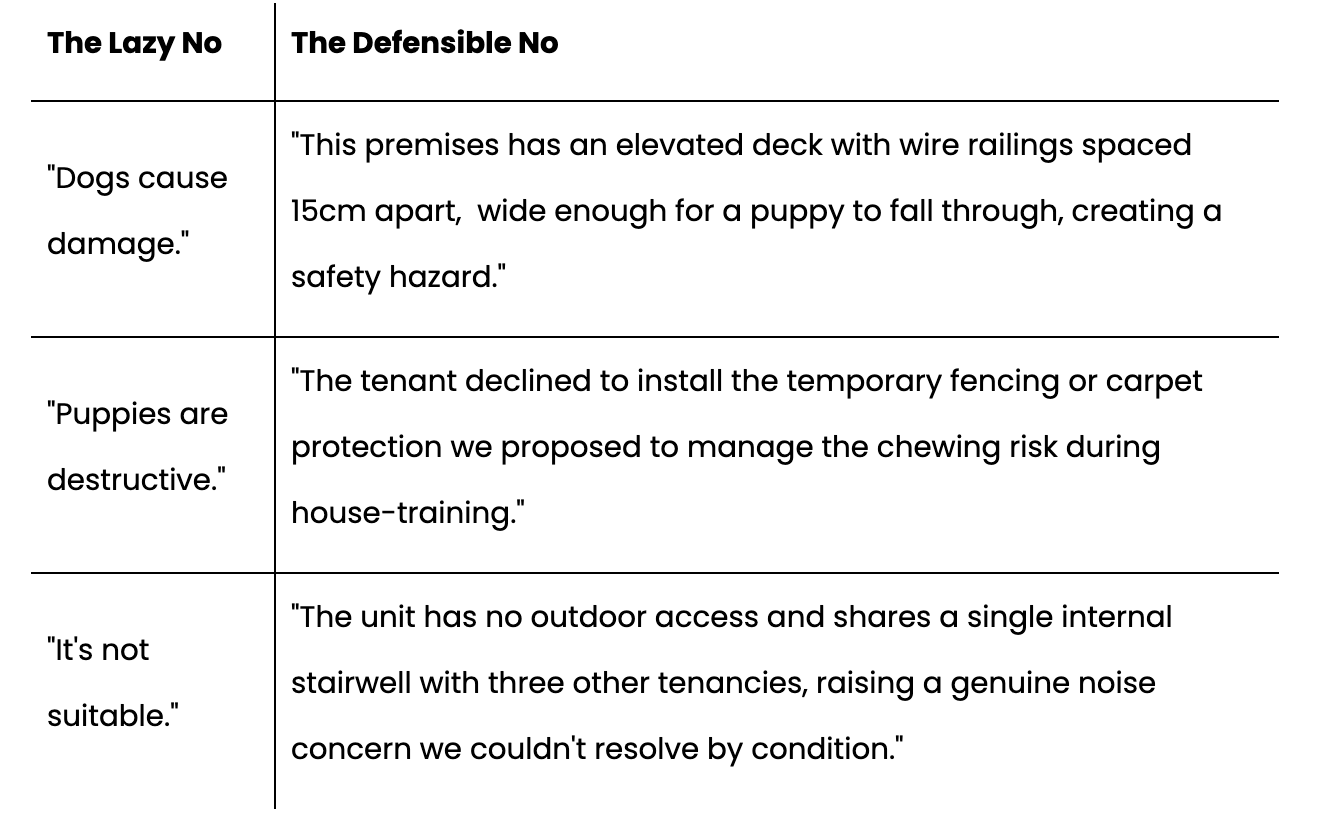
See the difference? One column is lazy thinking. The other is a concern you could defend out loud to a reasonable stranger. Put it in writing. Send it to the tenant within 21 days.
Stage Two (Reasonableness): Were the reasons relied on reasonable?
Would a reasonable landlord, someone who understands the law's text and purpose, refuse consent on these grounds?
Not: "Do I feel nervous about this?"
But: "Can I defend this decision using clear principles?"
This is where the framework gets powerful. Because the adjudicator didn't leave you guessing about what "reasonable" means. He gave us a list of (non-exhaustive) principles.
Your six-principles starter pack
Adjudicator Cater offered six principles for Stage Two. Don't treat these as suggestions, see them for what they are: expectations.
Landlords should consider requests in good faith.
Landlords must consider the premises and the particular pet.
Grounds must be more than hypothetical.
Landlords should consider whether conditions could mitigate concerns.
Landlords must consent to any minor change that makes the premises suitable.
Landlords must provide a clear written response for any refusal.
Here's what makes this case instructive. The landlord had legitimate concerns: unfenced property, a deck with safety gaps, inadequate outdoor space. These were real problems, he didn't make them up. But, and this is critical, he never genuinely engaged with the tenant's proposed solutions.
The tenants offered mats. Barriers. Temporary fencing they'd install themselves. Supervision protocols. Professional carpet cleaning at move-out. The landlord's response? Generic handwaving about risk. That's the lazy no losing to the hard-fought yes. And the Tribunal called it what it was: unreasonable.
Eight more (Because I am that person)
So Adjudicator Carter said his list is non-exhaustive. Ok. Challenge accepted.
Following his method, I'm throwing in another eight. Not legal advice, just my take on what the rules require and how I expect landlords to apply them.
Write the reason down the day you decide. Hindsight doesn't count - Common trap: a thin, gut-feel "no," the tenant pushes back, and then, three months later at the Tribunal, a beautifully reasoned, lawyer-shaped set of concerns materialises. Doesn't work. Stage One looks at the reasons "given for the refusal," not the ones you wish you'd given; the Court of Appeal calls it the search for "the actual basis for withholding consent." A vague refusal at the time can be read as evidence you never had reasonable grounds. Do the thinking before you hit send, and write it down. Contemporaneous notes beat revisionist storytelling every time.
Your reasons must be about the pet, the premises or the tenancy, not about how you feel about the tenant - A landlord cannot refuse "on grounds which have nothing whatever to do with the relationship of landlord and tenant in regard to the subject matter of the lease." So your concern must connect to the pet, the premises, or a legitimate tenancy interest. Not that you find the tenant annoying, or want them gone, or just don't like animals. And the kicker: a collateral motive can poison the whole refusal even if a legitimate concern is also in the mix. Check your own motive before you check anything else.
Your must be reasonable but you don’t have to be right - You don't need to prove the puppy would have chewed the skirting boards; you're a landlord, not the Oracle. The standard is to show your "conduct was reasonable, not that it was right or justifiable" i.e. a conclusion a reasonable landlord could reach on the information available. Reasonable belief, yes. Suspicions, feelings, vibes, no. And notice the asymmetry working in your favour: a documented, reasonable no carries a small, capped downside even if you turn out to be wrong. A lazy no carries an unbounded one including an unlawful act finding, damages, a burnt client relationship. Same five minutes of effort, wildly different risk. Do the work.
Stop looking for a rule. There isn't one and that’s ok - Everyone's after a magic flowchart that spits out a definite yes or no and indemnifies them to the sun and back. Sorry, it doesn't exist, and the courts keep telling us so. "Reasonableness" was chosen because it resists rigid rules; it is "propositions of good sense… rather than propositions of law applicable to all cases". Adjudicator Carter puts it plainly: assessment of reasonableness "should not be constrained by rigid rules." That’s a good thing because that flexibility is on your side. A rigid checklist would be gamed by bad-faith landlords and would shatter on the first genuinely odd case. The discretion is exactly what lets a good operator win on the merits. So treat all of this wibble-wobble: my principles, his, even the section 42F examples, as aids to judgment, not boxes to tick. Every consent is decided afresh.
Human right protections are the floor, don’t mess with them - This one I most want you to internalise, because it operates above the framework. We all know disability assist dogs aren't "pets" under these provisions, but that carve-out is more than a quirky exception. A tenant relying on a disability assist dog is exercising a right tied to their disability, which is a prohibited ground of discrimination under the Human Rights Act 1993. The signpost from that: a pet decision can never become a vehicle for discrimination, on disability or any other protected ground. A refusal that's really a proxy for a protected characteristic must fail on arrival.
Mitigation goes two ways - The Christchurch puppy case looks like a one-sided story: bad landlord ignores good tenant. The principle underneath is fairer than that. Yes, the onus is on the landlord to genuinely consider conditions, including the tenant's own, and that's where the Christchurch landlord came unstuck: real concerns, zero engagement with the mats, barriers and temporary fencing on offer. The classic lazy no. But the courts have been explicit that the duty runs both ways: a party who "refused to engage constructively" or stays "obstinate, refusing to make minor adjustments" may have their concerns "attributed less weight," and a tenant's refusal of reasonable conditions is itself a ground for declining (section 42F). No free pass for anyone. Document the conversation, the back-and-forth is often the difference between a defensible decision and an indefensible one.
Conditions have to be reasonable too. You can't smuggle a no inside a yes, but… -This one never ages well: the landlord who deep down doesn't want the pet, knows an outright refusal is shaky, so says "yes, but…" then stacks on conditions no tenant could meet. Monthly inspections. A grooming receipt every fortnight. Health insurance for the pet. Enrolment at puppy school. A yes engineered to function as a no. The statute is clear: a condition "must be reasonable having regard to the nature of the premises and the type of pet," and an unreasonable condition is itself an unlawful act. So match the condition to the risk, deck mats for a deck, carpet cleaning for an indoor animal, restraint during inspections for access. Anything punitive, disproportionate or unrelated to the genuine concern is a no-no wolf dressed up as a yes-yes lamb. We all see it from a mile off.
The pet bond and damage rules exist to get you to a yes - When property managers tell me they're worried about damage, my first question is always the same: have you accounted for the bond? Parliament didn't hang landlords out to dry, it built a financial safety net: a pet bond, plus expanded liability making tenants responsible for all pet-related damage beyond fair wear and tear. The policy papers call that combination the very mechanism "to remove a key barrier to landlords allowing pets." So most "risk of damage" refusals are weaker than they feel, because the risk is already covered by money you're holding and liability the tenant carries. Before you refuse on damage grounds, ask honestly whether the bond, full liability and a couple of sensible conditions cover the realistic risk. If they do, your no is on borrowed time. Genuinely irreplaceable risks such as a heritage feature you can't put a price on are a different conversation. But those are very rare.
Your reasonable litmus test
Six principles from the Tribunal, eight from me, and one underlying message: "reasonable" is a process that can be learned, documented, and defended.
So before any pet no leaves your outbox, run these three questions:
Have I written a specific reason about this pet at this property, not a generic worry about dogs, puppies or "what ifs"?
Have I genuinely engaged with the tenant's proposed conditions, and asked whether the bond plus full liability already covers the risk? Alternatively, have I proposed any reasonable conditions in good faith so I can get my owner to a yes?
Could I defend this decision out loud, to a reasonable stranger, without flinching?
If it's yes to all three, you're on solid ground. If you hesitated on any of them go back to the drawing board.
* Just look at how the adjudicators are more heavy handed about Healthy Homes penalties compared to five years ago.
